The Small Airport Advantage Is Real, But Not Where You Think
Small airports beat hubs on quiet hours, not on peak waits. Tallahassee peaks at 120 minutes. Here's how to read that tradeoff without getting it backwards.
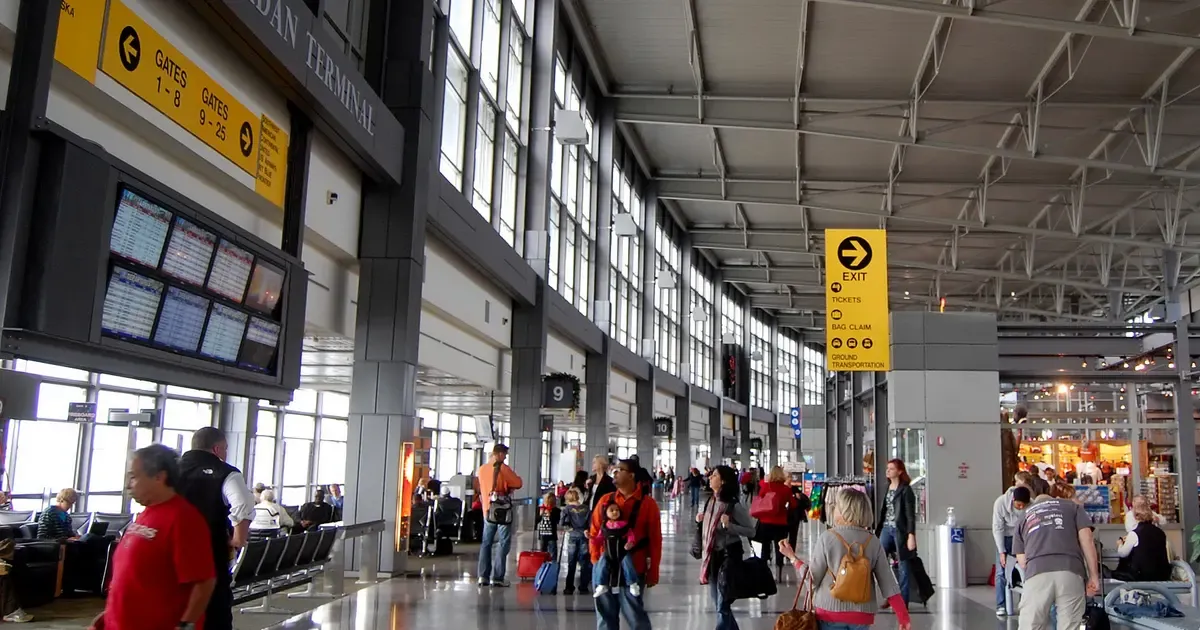
Tallahassee’s airport peaks at 120 minutes. That’s longer than any hub in the data — longer than JFK, LAX, O’Hare, Denver or Atlanta at their absolute worst. And Tallahassee handles a tiny fraction of the traffic.
The small-airport advantage is real. It just isn’t the one most people describe.
Where do small airports actually win?
On quiet hours, and the margin is enormous.
Chicago Midway logs 127 hourly slots at five minutes or under across the week. Des Moines logs 123. Washington Dulles logs 119. Kansas City logs 109. Cincinnati logs 104. Syracuse logs 100. Buffalo logs 97. Albany logs 87. Tallahassee, despite its 120-minute peak, logs 83.
Now the hubs. JFK logs zero. LAX logs 10. Houston logs 12. Denver logs 21. Dallas logs 23. O’Hare logs 28. Atlanta logs 34.
That’s the whole advantage in one comparison. At a small airport, most hours of most days you walk straight through. At a hub, there is no such hour — the floor never drops.
Then why do small airports have worse peaks?
Lane count. It’s the entire explanation.
A hub checkpoint has fifteen or twenty lanes and can open more when a bank arrives. When demand spikes, capacity flexes to meet it, and the queue grows moderately rather than catastrophically.
A regional airport has three lanes, or four. That’s a hard ceiling. When a departure bank produces more passengers per hour than three lanes can screen, the queue doesn’t grow moderately — it grows until the bank has cleared, and the length is a function of how far demand exceeded capacity and for how long.
That’s why Tallahassee produces 120 minutes at 8 AM on a Friday and 22 minutes as its worst hour on every other day. It’s not that Friday is dramatically busier. It’s that Friday morning crosses the capacity ceiling and the other days don’t.
Same mechanism at Lihue, which hits 70 minutes on Thursday at noon. Pensacola, 68 minutes on Monday at 6 PM. Ontario, 63 minutes on Saturday at 5 AM. Indianapolis, 63 minutes on Friday at 6 AM. Asheville, 58 minutes on Sunday at 6 AM.
Every one of those is a bank exceeding a small checkpoint’s ceiling. Every one is surrounded by hours where the same airport is empty.
So which should I choose?
For the ordinary trip, the small airport, and the reasoning is straightforward.
You have a specific flight at a specific hour. If you can identify the airport’s bad hours and your flight isn’t in one, the small airport gives you a five-minute checkpoint, a two-minute walk to your gate, and parking 200 feet from the door. The hub gives you an 18-minute checkpoint, a fifteen-minute walk, and a shuttle from remote parking.
The small airport wins that comparison decisively, and it wins it most of the time.
Where it loses is the trip that can’t slip.
What’s the actual risk at a small airport?
Schedule depth, not security.
A regional airport runs a handful of daily departures to each destination. If your flight cancels at Asheville or Hayden or Pensacola, the rebooking options are thin — potentially tomorrow rather than in two hours.
At a hub, a cancellation is an inconvenience. There’s another flight to almost anywhere within a few hours, and often several. The airline has aircraft and crews on site to recover with.
That difference matters enormously for some trips and not at all for others. Flying home from vacation with a flexible Monday? The small airport is fine. Flying to a wedding you have to be at Saturday afternoon? The hub’s depth is worth more than the checkpoint difference, and it isn’t close.
How do I identify a small airport’s bad hours?
Two patterns cover almost all of them.
The pre-dawn bank. Most regional airports peak between 4 and 6 AM, when the first departure wave hits a checkpoint that just opened. Asheville, Ontario, Indianapolis, Buffalo, Cincinnati, Syracuse, Albany, Kansas City and Tallahassee all follow this shape.
The destination-market inversion. Leisure destinations peak midday or evening instead, because there’s no reason to schedule a 5 AM departure from a beach or an island. Lihue peaks at noon. San Jose peaks at 4 PM. The Colorado mountain airports — Aspen, Eagle and Hayden — all peak between 11 AM and 3 PM.
Figure out which type your airport is and you’ve found the hours to avoid. You can check the hourly view directly: Tallahassee, Lihue, Midway.
Does this change how much buffer I need?
Yes, and in a way that’s easy to get backwards.
At a hub, your buffer is mostly fixed overhead — remote parking, a shuttle, a long walk, an inter-terminal train. The checkpoint is a moderate and predictable part of it. Two hours at JFK is two hours because of the airport, not because of the line.
At a small airport, the overhead is minimal. Parking is close, the walk is short, and the checkpoint is essentially your whole timeline. That means your buffer should be driven almost entirely by the hour you’re flying: 75 minutes at Cincinnati on a Wednesday, two hours at Asheville on a Sunday morning.
The mistake is applying a flat rule to both. A flat two hours wastes 45 minutes at a small airport six days a week and is insufficient on the seventh.
The version to actually use
Ordinary trip, flexible arrival: small airport, and check the hour.
Hard deadline on the other end: hub, for the rebooking depth.
Peak hour at a small airport, no flexibility: budget two hours and consider whether TSA PreCheck is worth it — the value is highest at exactly these airports, where the standard line can be 60 minutes and the PreCheck lane is nearly empty.
Any hub: budget the airport’s fixed overhead plus 20 minutes of checkpoint, and stop trying to optimize the hour. There isn’t a good one.
And if you’re connecting off an international arrival, the small-airport advantage extends to customs too. Buffalo clears in 14 minutes and Cincinnati in 22, against 77 at JFK and 79 at San Francisco. CBP publishes its own wait-time data if you’re weighing entry points.
Frequently asked questions
Are small airports faster than big ones?
On average, yes — small airports have far more genuinely quiet hours. At peak they can be much worse: Tallahassee hits 120 minutes and Lihue hits 70, both higher than any major hub in the data.
Why do small airports have such sharp peaks?
Limited lane count. A hub can open fifteen screening lanes to absorb a surge. A regional airport with three lanes has a hard ceiling, and once the departure bank exceeds it the queue just grows.
What's the biggest risk at a small airport?
Schedule depth. Small airports run a handful of daily departures per destination, so a cancellation can mean waiting until the next day rather than two hours.
When should I choose the hub over the regional airport?
When the trip has a hard deadline on the other end — a wedding, a cruise departure, a same-day return. The hub's rebooking options are worth more than the checkpoint difference.
Sources
- TSA PreCheck
Transportation Security Administration · tsa.gov
- CBP publishes its own wait-time data
U.S. Customs and Border Protection · cbp.gov
- Airline On-Time Performance Data
Bureau of Transportation Statistics · transtats.bts.gov
- Tallahassee Regional Airport official website
Tallahassee Regional Airport · talgov.com
Keep reading
 strategyJFKLAX
How Early to Arrive: A Buffer Table for 20 US Airports
Two hours isn't a rule, it's an average of airports that behave nothing alike. Here's the buffer each one actually needs, built from real hourly data.
FlyIndex Editorial strategyTLHDFW
What a 'Peak Wait' Actually Measures, and What It Misses
A 70-minute peak and a 70-minute average are completely different problems. Here's how to read airport wait-time data without drawing the wrong conclusion.
FlyIndex Editorial strategyMDWJFK
The Quiet-Slot Count Is the Airport Stat Nobody Checks
Midway logs 127 hourly slots under five minutes. JFK logs zero. This one number tells you more about an airport than its headline peak wait ever will.
FlyIndex Editorial