All 107 U.S. Customs Halls Peak Between 2 and 5 PM
Not one of the 107 international gateways in our data peaks outside the 2 to 5 PM window, and 72 of them peak at exactly 4 PM. What that means for arrivals.
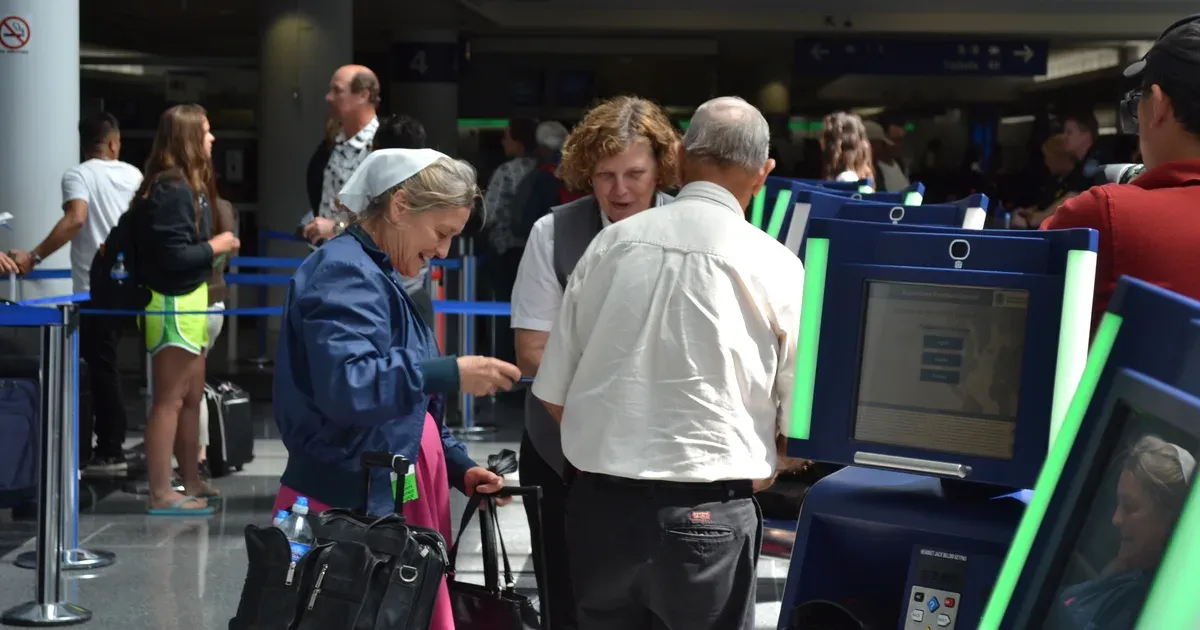
We ran the peak hour for every one of the 107 international gateways with immigration wait-time data on FlyIndex, expecting a spread. There isn’t one. All 107 peak between 2 PM and 5 PM. Not a single airport in the set peaks in the morning, in the evening, or overnight.
Seventy-two of them peak at exactly 4 PM. Another 29 peak at 3 PM. That leaves six airports for every other hour of the day, and all six are within an hour of the pack.
How tight is the clustering, exactly?
Tight enough that it stops looking like a pattern and starts looking like a schedule.
| Peak hour | Airports |
|---|---|
| 2 PM | 3 |
| 3 PM | 29 |
| 4 PM | 72 |
| 5 PM | 3 |
The six outliers: Anchorage, San Diego and Cincinnati peak at 2 PM; Myrtle Beach, Sacramento and St. Pete–Clearwater peak at 5 PM. Anchorage is the only one with an obvious explanation — its international traffic runs on a different geography from everyone else’s.
The peak day is nearly as concentrated. Sixty gateways peak on a Sunday, 45 on a Friday, and exactly two on a Saturday. No airport in the set posts its worst hour on a Monday, Tuesday, Wednesday or Thursday.
Why does everything land at once?
Long-haul schedules. A transatlantic flight leaving Europe late morning arrives in the eastern U.S. mid-afternoon; a transpacific flight leaving Asia in the evening arrives on the West Coast late morning to early afternoon, and the second wave behind it lands into the same window. Airlines schedule to connect passengers onward the same day, which pushes arrivals into a band, and the band is the afternoon.
CBP staffs against that curve, but staffing a peak and eliminating one are different things. The hall gets a crowd that arrived in ninety minutes and has to process it at whatever rate the booths allow.
What the curve looks like at a big gateway
Here’s Sunday at San Francisco, hour by hour, which is the worst single day in the entire data set:
- 3 AM — 1 minute
- 6 AM — 25 minutes
- 9 AM — 42 minutes
- 12 PM — 55 minutes
- 3 PM — 72 minutes
- 4 PM — 79 minutes
- 6 PM — 57 minutes
- 9 PM — 34 minutes
That’s a nine-hour climb and a five-hour descent. JFK’s Sunday does the same shape at a slightly different scale: 41 minutes at 10 AM, 77 at 3 PM. O’Hare climbs from 42 at 9 AM to 78 at 4 PM.
The useful read isn’t the peak. It’s the slope. At every one of these airports, an arrival seven hours before the peak clears in roughly half the time, and an arrival three hours after the peak clears in a bit more than half.
What does landing at 10 AM actually save you?
Roughly half the wait, at every big gateway, on the worst day of the week. These are the Sunday figures:
| Airport | 10 AM | Peak | Saved |
|---|---|---|---|
| SFO | 47 | 79 | 32 min |
| ORD | 38 | 78 | 40 min |
| JFK | 41 | 77 | 36 min |
| LAX | 41 | 77 | 36 min |
| EWR | 41 | 76 | 35 min |
| ATL | 48 | 75 | 27 min |
| MIA | 41 | 74 | 33 min |
Thirty-odd minutes is not a rounding error when you’re the last row off a 747 with a domestic connection to make. It’s also worth noticing that a 10 AM arrival is not a quiet arrival — 41 minutes at JFK is still a long hall. The morning advantage is real and it is not the same thing as an empty airport.
Does the size of the peak vary? Enormously.
This is the part worth holding onto: the timing is nearly identical everywhere, but the magnitude is not.
| Airport | Peak wait | Peak slot |
|---|---|---|
| SFO | 79 min | Sunday 4 PM |
| ORD | 78 min | Sunday 4 PM |
| JFK / LAX | 77 min | Sunday 3 PM |
| EWR | 76 min | Sunday 4 PM |
| DFW / DEN | 53 min | Sunday 4 PM |
| SEA | 52 min | Friday 4 PM |
| SJC | 14 min | Friday 3 PM |
San Jose peaks in the same hour as San Francisco and finishes 65 minutes ahead of it. Same afternoon, same region, same structural pattern — a completely different experience, because the volume landing into San Jose’s hall is a fraction of what lands 40 miles north.
So the airport choice is the lever with the range. The hour choice is the lever that always points the same direction.
What to actually do with this
If you can pick your arrival time, pick the morning. Not because mornings are magic, but because you’re landing on the left side of a curve that only goes up until 4 PM. An 8 AM arrival at any major gateway meets a hall running at roughly a third of its daily worst.
If you can’t, plan the connection around 4 PM, not around the flight. A 4:20 PM arrival at SFO with a two-hour domestic connection is a coin flip in this data, and it’s the same coin flip at O’Hare, Newark and Atlanta. Three hours makes it a non-event.
Don’t assume a smaller airport is faster on percentage. It’s faster in absolute minutes, which is what matters, but it peaks at exactly the same time. Buffalo, Greensboro and Wilkes-Barre/Scranton all top out at 14 minutes — in the afternoon, like everyone else.
Global Entry moves the whole curve down, and its value is highest precisely in this window. We ran that math separately in the Global Entry analysis.
There’s a version of this post that ends with a tidy rule, and the rule would be: land before noon. But the more interesting finding is the one that surprised us going in. A hundred and seven airports, from Kennedy to Key West, and not one of them has its own schedule. They all run on the same afternoon.
If you want to go deeper on picking an arrival airport rather than an arrival hour, the immigration-data strategy piece covers the spread between gateways in detail.
Frequently asked questions
What time are customs lines longest at U.S. airports?
Between 2 PM and 5 PM, at every single one of the 107 gateways in FlyIndex data. 4 PM is the peak hour at 72 of them and 3 PM at 29 more.
What is the best time to land in the U.S. from abroad?
Early morning. Between roughly 2 AM and 5 AM the big gateways run single-digit waits, and by 9 AM they are still only about half of their afternoon peak.
Which U.S. airport has the longest customs wait?
San Francisco, at 79 minutes on Sunday at 4 PM. O'Hare is second at 78, then JFK and LAX at 77 each.
Why do customs halls peak in the afternoon?
Because the transatlantic and transpacific arrival banks land then. Long-haul flights from Europe and Asia are scheduled to arrive in the U.S. afternoon, and they land within a couple of hours of each other.
Does the peak hour change by day of the week?
Barely. The peak day shifts — 60 gateways peak on Sunday and 45 on Friday — but the peak hour stays in the 3 to 4 PM range regardless.
Sources
- Airport Wait Times
U.S. Customs and Border Protection · awt.cbp.gov
- Travel
U.S. Customs and Border Protection · cbp.gov
- Airline On-Time Performance Data
Bureau of Transportation Statistics · transtats.bts.gov
Keep reading
 internationalSFOHNL
Friday Airports and Sunday Airports: Customs by Day
The seven busiest U.S. customs halls all peak on a Sunday. Hawaii, Puerto Rico and the Virgin Islands peak on a Friday. Which one is your gateway?
FlyIndex Editorial strategySFOSJC
Use Immigration Wait Data to Pick Your International Flight
Customs waits range from 79 minutes at SFO down to 14 at San Jose. Here's how to use immigration data to pick your arrival airport and your landing time.
FlyIndex Editorial internationalORD
O'Hare's 78-Minute Sunday Afternoon Customs Line
ORD's immigration wait peaks at 78 minutes on Sunday at 4 PM, the second-worst in our data. Here's the pattern at the Midwest's busiest gateway.
FlyIndex Editorial