Which LAX Terminal Does Your Airline Actually Use?
LAX runs 9 terminals and your airline decides which one you need. Here is the airline-by-airline map, the transfer rules, and when security actually bites.
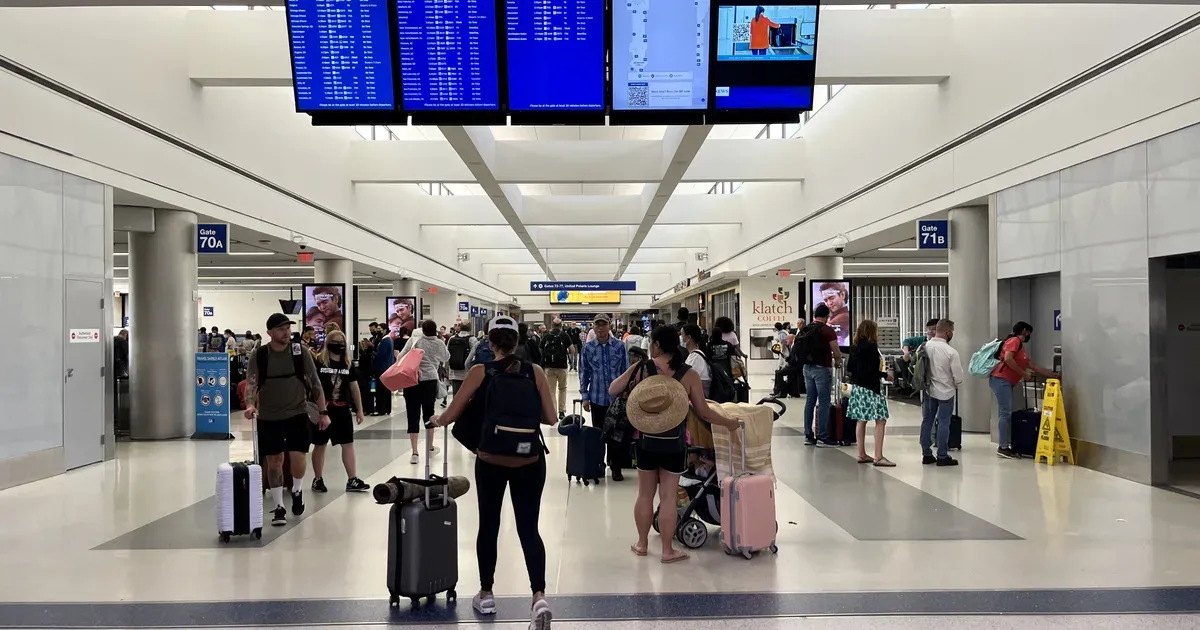
LAX has nine terminal buildings wrapped around a single roadway — eight of them open, since Terminal 5 was demolished in late 2025 — and the difference between picking the right one and the wrong one is about forty minutes of your life. The FlyIndex directory counts those nine terminals, 97 restaurants and 86 shops — the deepest retail footprint of any airport we track except Miami. The catch is that all of it is distributed around a horseshoe, and the horseshoe does not forgive guessing.
Which LAX terminal does my airline use?
The rough map, which is stable enough to plan around but not stable enough to bet a boarding pass on:
| Terminal | Generally used by |
|---|---|
| Terminal 1 | Southwest, JetBlue |
| Terminal 2 | Delta, Spirit |
| Terminal 3 | Delta and partners |
| Terminal 4 | American |
| Terminal 5 | Closed — demolished, due back 2028 |
| Terminal 6 | Alaska, some United |
| Terminals 7 and 8 | United |
| Tom Bradley (TBIT / Terminal B) | Most international carriers |
Terminal 5 is the one that catches people. It stopped handling passengers on 28 October 2025 and the building came down the following month, so a booking made before then may name a terminal that is not there. Its three airlines moved out over the preceding week: JetBlue to Terminal 1, Spirit to Terminal 2, and American to Terminal 4. The Terminal 5 closure page has the full relocation table and the rebuild timeline.
Airline assignments at LAX move around more than at most airports — construction shuffles gates, and codeshare flights depart from the operating carrier’s terminal, not the one that sold you the ticket. Confirm the terminal on your boarding pass, then confirm it again against the LAX terminal guide if the itinerary involves a partner airline or a booking made before the Terminal 5 closure. The count is the thing to hold onto: this is a big building disguised as several smaller ones.
The international wrinkle
Tom Bradley handles the bulk of long-haul departures, but not all of them. Several international carriers operate out of the numbered terminals, and a few airlines check you in at one terminal and board you at another. If your flight leaves the country, read the departure terminal twice. The cost of getting it wrong here is higher than anywhere else at LAX, because TBIT sits at the far end of the horseshoe from Terminal 1.
Can you move between terminals after security?
Partly, and this is the single most useful thing to know about LAX.
Several terminals are joined behind security by airside walkways, so a connection between them is a walk rather than an ordeal. Others aren’t connected, which means exiting to the horseshoe, walking or shuttling to the next terminal, and clearing a checkpoint for the second time in an hour. The connected pairs have grown over the past few years as construction has finished, so verify the current picture on the official LAX terminal map rather than trusting a memory from three years ago.
The practical rule: if you have a connection under 90 minutes and it crosses terminals, find out before you land whether the two are joined airside. If they aren’t, treat it as a separate airport transfer and be honest with yourself about whether it fits.
When does security actually bite at LAX?
Sunday at 9 AM. FlyIndex’s TSA wait data puts the LAX peak at 25 minutes in that slot.
Twenty-five minutes is lower than most people expect for an airport of this size — lower than O’Hare’s 30, well under Miami’s 46. LAX’s reputation is worse than its checkpoint numbers. What earns the reputation is everything wrapped around the checkpoint: the roadway, the parking, the distance from the curb to a gate at the end of a long pier.
The morning timing is the detail that catches people. At most big hubs the crush is a Sunday-afternoon return wave. At LAX it’s a morning departure bank, which means a traveler who has learned to avoid Sunday afternoons everywhere else will walk straight into it here. Hourly detail sits on the LAX TSA wait times page.
The other number worth knowing: 10 quiet slots per week, at 1 AM and midnight. That’s thin. O’Hare has 28, Miami has 29. LAX simply doesn’t go quiet, because it’s absorbing transpacific departures long after other airports have shut down for the night. So the strategy here isn’t finding a clever hour — there mostly isn’t one. It’s arriving with a real buffer.
Arrival timing by scenario
- Domestic, Sunday morning: 2 hours 30 minutes at the curb.
- Domestic, off-peak: 2 hours, and you’ll likely have time to spare.
- International, any day: 3 hours. Bag-drop cutoffs are earlier and the walk is longer.
- Connecting between unconnected terminals: add 45 minutes to whatever you’d otherwise allow.
What about arrivals from abroad?
Immigration peaks at 77 minutes on Sundays at 3 PM, per our LAX immigration wait data. Three times the TSA peak. That’s where connection times actually break — not at security, not at the gate, but in a hall with several hundred people and a slow-moving queue for primary inspection.
If you’re connecting to a domestic flight after an international arrival on a Sunday afternoon, two and a half hours is the minimum we’d accept, and three is better if the onward flight leaves from a terminal that isn’t connected airside to where you cleared customs. The itinerary that says 1 hour 20 is a fiction on paper.
The upside of nine terminals
Ninety-seven restaurants and 86 shops is a genuinely deep bench, and it changes what a delay feels like. A two-hour hold at LAX is survivable in a way that the same delay at O’Hare — 35 restaurants, 9 shops — is not. The caveat is the same as always: those 97 restaurants are spread across nine buildings, and only the ones in your terminal count. Nine terminals worth of options, one terminal’s worth of access.
So look up your terminal’s dining list before you plan a meal, not after you’ve cleared security and started walking hopefully.
One concrete habit that saves the most grief here: check the departure terminal the night before, then check it again when you get the gate assignment. LAX moves flights between terminals more often than it should, and the horseshoe is a long way around at 8:40 AM on a Sunday.
Frequently asked questions
How many terminals does LAX have?
Nine buildings, eight of them open. Terminals 1 through 8 plus the Tom Bradley International Terminal ring a central roadway, but Terminal 5 closed on 28 October 2025 and was demolished; a replacement is due before the 2028 Olympics.
Can I walk between terminals at LAX after security?
Some of them, not all. Certain terminal pairs are joined by airside walkways, while others require exiting to the horseshoe and clearing security a second time. Check the current airside connections on the LAX official map before you count on a short walk.
What time is security worst at LAX?
Sunday at 9 AM, where FlyIndex's TSA data records a 25-minute peak. The morning timing surprises people — the LAX crush is a departure-bank problem, not an afternoon-return problem the way it is at O'Hare.
How early should I arrive at LAX?
Two and a half hours for domestic in the Sunday-morning window, two hours off-peak. International, make it three — the terminal is large, the walk to a gate can be long, and bag-drop cutoffs are earlier.
Is there a quiet time to clear security at LAX?
Barely. LAX logs 10 quiet slots per week, at 1 AM and midnight. That's a narrow window compared with O'Hare's 28 or Miami's 29, so at LAX the reliable strategy is a bigger buffer rather than a cleverer departure time.
Sources
- Los Angeles International Airport
Los Angeles World Airports · flylax.com
- TSA Security Screening
Transportation Security Administration · tsa.gov
Keep reading
 terminalsLAX
LAX Terminals Explained: Which One Do You Actually Need
LAX runs 9 terminals, 97 restaurants and 86 shops. Here's which one your airline uses, how to move between them, and when security is worth 25 minutes.
FlyIndex Editorial terminalsLAX
LAX Terminal 4: What It Has Since American Moved In
LAX Terminal 4 is American Airlines' terminal, not Delta's, and it absorbed Terminal 5 in October 2025. What is in it, what closed, and how the walk works.
FlyIndex Editorial terminalsLAX
LAX West Gates: The Hidden Terminal Inside Tom Bradley
LAX's West Gates satellite holds gates 201 through 226 and only six places to eat. Here's how to get out there, and how long that walk actually takes.
FlyIndex Editorial