Know Your MIA Terminal Before You Leave for the Airport
MIA runs 5 terminals with a 46-minute Monday noon TSA peak. Verify your airline terminal before leaving and use ORD's 4-terminal contrast to plan curb to gate.
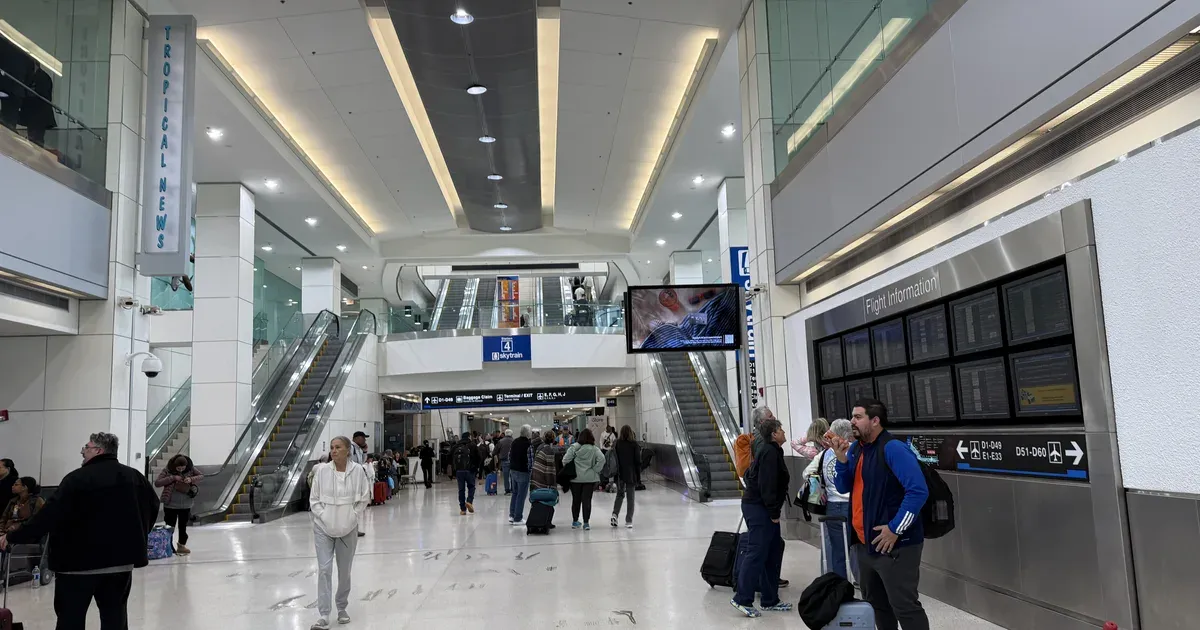
If you’re flying out of Miami, check your airline’s terminal before you head for the airport. MIA runs 5 terminals, holds 107 restaurants and 133 shops, and hits a 46-minute TSA peak on Mondays at 12 PM, so the wrong drop-off turns into a long backtrack. ORD runs 4 terminals with a 30-minute peak on Sundays at 3 PM, which looks calmer on paper, but my read is the same at both: the terminal check is the trip.
Which terminal setup are you walking into at MIA?
MIA is big in a way that punishes guessing. According to FlyIndex’s historical data for MIA, the airport lists 5 terminals with 107 restaurants and 133 shops tucked inside them, and honestly that density changes how you should think about the curb. You’re not picking a door, you’re picking a zone, and a wrong turn means a landside walk while the clock ticks toward that Monday noon crush.
Compare that with O’Hare. In FlyIndex’s data for ORD, the count is 4 terminals with 35 restaurants and 9 shops, which is a fraction of Miami’s food and retail sprawl. I’d call ORD compact by comparison, not small, but the penalty for a bad guess is kind of lower because there are fewer buildings to bounce between. Look, both airports will make you ride a train or hike a connector if you blow it, but MIA’s extra terminal and shopping halls tell you the distances are longer and the signage load is heavier.
Don’t overthink the maps. The MIA terminals guide lays out the 5-terminal split better than any static PDF, and I check it against the airline’s own app rather than trusting either one alone. For what it’s worth, my rule is blunt: if your boarding pass and the airport board disagree, believe the boarding pass for the next hour and re-check after. Your mileage may vary on a codeshare morning, when the marketing carrier and the operating carrier point at different curbs.
A quiet tell I like. MIA’s 133-shop footprint means you’ll see shopping corridors used as wayfinding landmarks, while ORD’s 9-shop count means gate numbers do more work and food signs do less. It’s a small thing. Still, when you’re half-awake and hunting coffee, that difference tells you which airport you’re in. Don’t sleep on it.
How can you be sure of your MIA terminal before you leave?
Trust the morning-of screen, not the ticket you bought weeks ago. Assignments drift, seasonal swaps happen, and at an airport with 5 terminals there’s always room for a last-minute gate shuffle to drag your check-in to a different curb. I’d run a quick chain and call it done.
- Open the airline app after you wake up and screenshot the terminal and curb.
- Match it to the departure board on the official airport site.
- Glance at the Miami International Airport hub for any operational note that morning.
That chain takes a minute and it beats standing under the wrong overhang with a 46-minute Monday noon line building inside.
Here’s the direct answer I’d give a friend: for MIA, confirm the terminal in your airline app the morning you fly, screenshot it, then re-check the board when you’re in the car. According to FlyIndex’s historical TSA data for MIA, the peak hits 46 minutes on Mondays at 12 PM, with 29 quiet slots in the data and the calmest spells at 1 AM, 12 AM and 2 AM. You won’t fly at those overnight hours, obviously, but the point holds — midday Monday is the crunch, so a terminal mistake then costs more than the same mistake at dawn.
Don’t rely on memory. Travelers love to quote the terminal they used last year like it’s a lease. It’s not. Carriers move, construction nudges doors, and codeshares blur everything. Look at today’s screen.
| Where to look | What to match | Why it matters with 5 terminals |
|---|---|---|
| Airline app | terminal and check-in curb | catches the overnight swap |
| Boarding pass | terminal code | must match the app |
| Airport departure board | current assignment | catches the morning move |
If two agree and one doesn’t, go with the pair. Then check again curbside.
What does ORD show you by contrast?
ORD is the cleaner comparison because it’s close in stress but different in shape. FlyIndex’s data puts O’Hare at 4 terminals, 35 restaurants and 9 shops, with a TSA peak of 30 minutes on Sundays at 3 PM and 28 quiet slots in the data. That’s a terminal fewer than MIA, a much smaller food floor, and a peak that’s lower than MIA’s 46 minutes on Mondays at 12 PM but still enough to ruin a tight connection. See the O’Hare terminals page side by side with MIA and the shape difference jumps out.
Immigration tells a similar story. MIA peaks at 74 minutes on Sundays at 3 PM, ORD at 78 minutes on Sundays at 4 PM, according to FlyIndex’s data. Different hour, same Sunday pain, and honestly I’d plan both the same way if you’re arriving from abroad and connecting. Don’t assume the Chicago layout saves you — it doesn’t when the hall backs up.
The calm windows rhyme too. MIA’s calmest times are 1 AM, 12 AM and 2 AM, ORD’s are 2 AM, 1 AM and 10 PM. You’ll never book those on purpose, but they explain why midday and late afternoon feel heavy at both places. One caveat: overnight calm doesn’t help a noon departure, so use those numbers as background, not a plan.
When should timing change your terminal plan?
Midday Monday at MIA is the slot where I’d add real buffer for terminal confusion. A 46-minute TSA peak on Mondays at 12 PM doesn’t just mean a line, it means every landside mistake gets amplified because the re-entry queue is already long. If your airline app flips terminals mid-morning on a Monday — and apps do that — you don’t have slack to wander.
Sundays flip the script for connections. MIA’s immigration peak of 74 minutes on Sundays at 3 PM and ORD’s 78 minutes on Sundays at 4 PM mean an international arrival that morning needs a terminal plan for the second leg before you land. I look at the MIA immigration wait times pattern and the ORD TSA wait times pattern together here, because the second screening can hurt more than the first. Your mileage may vary with trusted-traveler lanes, but the base wait still sets the mood.
Here’s how I line them up:
| MIA | ORD | |
|---|---|---|
| Terminals | 5 | 4 |
| Restaurants / shops | 107 / 133 | 35 / 9 |
| TSA peak | 46 min Mondays at 12 PM | 30 min Sundays at 3 PM |
| Immigration peak | 74 min Sundays at 3 PM | 78 min Sundays at 4 PM |
| Quiet slots | 29 | 28 |
| Calmest times | 1 AM, 12 AM, 2 AM | 2 AM, 1 AM, 10 PM |
Use that table, don’t memorize it. The takeaway is kind of blunt: MIA gives you more buildings, more food, longer shopping halls, and a sharper Monday midday TSA spike, while ORD gives you a terminal fewer but an immigration peak that’s actually a touch higher. Neither airport gives you many truly quiet hours — 29 at MIA, 28 at ORD — so don’t count on an empty checkpoint.
Screenshot the terminal the night before, check it again with coffee, and head for the right curb. MIA rewards that second look.
Frequently asked questions
How do I know which terminal my airline uses at MIA?
Check your airline app the morning you fly, match the terminal code on your boarding pass, then match both to the departure board on the official airport site. MIA has 5 terminals and assignments shift, and with a 46-minute TSA peak on Mondays at 12 PM a wrong-curb mistake costs more at midday, so screenshot the result and re-check before you leave for the curb.
Is MIA harder than ORD for finding your terminal?
In layout, yes. MIA lists 5 terminals with 107 restaurants and 133 shops, while ORD lists 4 terminals with 35 restaurants and 9 shops in FlyIndex data, so Miami spreads you wider. For lines, MIA peaks at 46 minutes Mondays at 12 PM and ORD at 30 minutes Sundays at 3 PM, so both punish a wrong guess but Monday midday at MIA punishes it most.
When is security worst at MIA compared with ORD?
Mondays at 12 PM at MIA with a 46-minute peak, and Sundays at 3 PM at ORD with a 30-minute peak, according to FlyIndex data. MIA holds 29 quiet slots and ORD holds 28, with calmest times at 1 AM, 12 AM and 2 AM at MIA and 2 AM, 1 AM and 10 PM at ORD, so midday and Sunday afternoon run heaviest.
What should international arrivals expect on Sundays?
Long second lines. Immigration peaks at 74 minutes Sundays at 3 PM at MIA and 78 minutes Sundays at 4 PM at ORD in FlyIndex data. If you connect, confirm your onward terminal before you land and allow for that hall plus a second TSA pass, especially on Sunday afternoon.
Sources
- Miami International Airport
Miami-Dade Aviation Department · miami-airport.com
- O'Hare International Airport
Chicago Department of Aviation · flychicago.com
- U.S. Customs and Border Protection
U.S. Customs and Border Protection · cbp.gov
Keep reading
 terminalsMIA
How to Read MIA's Layout Before You Land: 5 Terminals
MIA has 5 terminals with 107 restaurants and 133 shops. Learn where TSA hits 46 minutes and immigration hits 74, and how to walk it without backtracking.
FlyIndex Editorial terminalsMIA
MIA's Central Terminal: The E, F, and G Gates Explained
Miami's Central Terminal holds the E, F and G concourses, 32 restaurants and the airport hotel. Here's how it connects and what's actually worth your time.
FlyIndex Editorial terminalsORD
ORD Terminal 5: The International Terminal Everyone Forgets
O'Hare's Terminal 5 handles the international arrivals, the customs flow, and a surprising share of the airport's dining. Here's how it works.
FlyIndex Editorial