The 90-Minute Connection Rule Doesn't Survive the Data
A 90-minute international connection works at some airports and fails badly at others. Here's the arithmetic, airport by airport, with the real numbers.
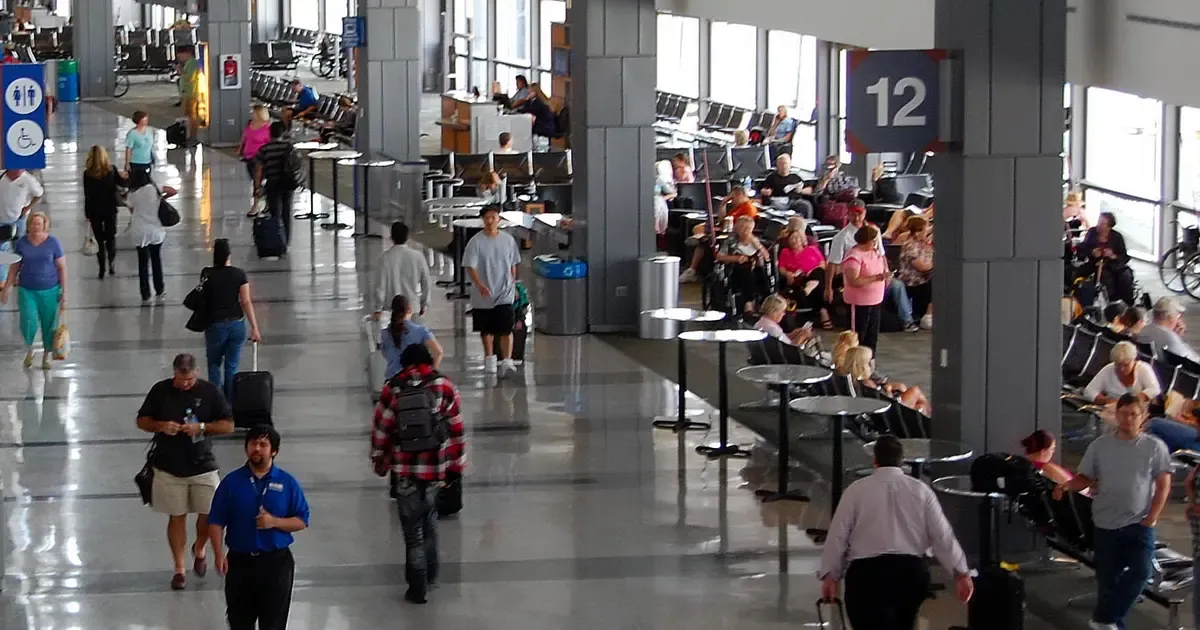
Ninety minutes is enough time to connect through Charlotte on a Tuesday. It is not enough time to connect through JFK on a Sunday afternoon, where customs alone runs 77 minutes and you still have four more steps to complete.
Both of those connections look identical in a booking engine. The engine’s minimum connect time is a static number set by the airport, and it does not know what day you’re flying or what hour you land.
What actually happens between the two flights?
Five steps, and customs is only one of them.
Step one: deplane and walk. Fifteen minutes from wheels down to the immigration hall on a good day. Longer at a big airport with a remote arrivals gate. This is dead time you can’t optimize.
Step two: immigration. The number everyone focuses on. It ranges from 14 minutes at San Jose to 79 at San Francisco depending on where and when you land.
Step three: bag claim. If you checked a bag, you’re waiting for it. Twenty minutes is typical after a widebody arrival, and it can be longer if two flights land together.
Step four: bag recheck. You drop the bag again on the connecting-flights belt. Five to fifteen minutes depending on the queue.
Step five: security re-clear. You go through TSA again. This one varies more than people expect — Houston’s checkpoint peaks at 60 minutes, Denver’s at 47.
Add them up and even a fast customs clearance leaves you with 55 to 70 minutes of unavoidable process.
Where does 90 minutes actually work?
At the inland hubs, on ordinary days.
Charlotte: customs peaks at 52 minutes on Sunday at 4 PM, but Tuesday runs 37 and Wednesday 35. TSA peaks at only 25 minutes. On a Tuesday, the full sequence runs about 95 minutes and a two-hour connection is comfortable. Ninety is tight but survivable if you’re not checking bags.
Denver: customs peaks at 53 minutes on Sunday at 4 PM, with Tuesday at 34. The complication is the TSA side — Denver peaks at 47 minutes on Saturday at 4 AM and logs only 21 quiet hourly slots, so the re-clear is more expensive than at Charlotte.
Dallas-Fort Worth: customs peaks at 53 on Sunday at 4 PM, Wednesday at 35. DFW’s TSA is unusually flat, running 28 to 32 minutes all week with a peak of 32. Predictable, which helps planning even though the number isn’t low.
Houston: customs peaks at 50 minutes on Friday and Sunday afternoons, with Tuesday at 30. But IAH’s TSA peaks at 60 minutes on Sunday at 6 AM and logs only 12 quiet hourly slots. The security re-clear is the expensive step here, not customs.
Where does 90 minutes fail?
At every coastal gateway, on the days most people fly.
JFK: 77 minutes at customs on Sunday at 3 and 4 PM, 75 on Friday at 3 PM. Add deplaning, bags, recheck and a TSA re-clear at an airport with zero quiet hourly slots, and you’re looking at two and a half hours minimum.
LAX: 77 minutes on Sunday at 3 PM, 72 on Friday at 5 PM. Same story.
O’Hare: 78 on Sunday at 4 PM, 66 on Friday at 4 PM.
San Francisco: 79 on Sunday at 4 PM — the highest number in the set.
Newark: 76 on Sunday at 4 PM.
Miami: 74 on Sunday at 3 PM, 71 on Friday at 3 PM, 68 on Saturday at 4 PM.
Every one of these peaks on Sunday afternoon, because that’s when the transatlantic and transpacific banks land. If your itinerary puts you in one of these halls between 3 and 5 PM on a Friday or Sunday, treat 90 minutes as impossible and 120 as optimistic.
Why is Sunday afternoon always the worst?
Because of flight physics, not scheduling preference.
A morning departure from Europe arrives on the US East Coast in the mid-afternoon. A morning departure from Asia arrives on the West Coast in the late morning to early afternoon. Both are constrained by flight time and time-zone shift, and airlines schedule into the connecting banks that exist on the other end.
The result is that virtually every US gateway sees its heaviest international arrivals between 2 and 5 PM, and Sunday is the heaviest leisure day. Look at the peak hours across the whole set: Charlotte 4 PM, Denver 4 PM, Dallas 4 PM, Houston 4 and 5 PM, JFK 3 and 4 PM, LAX 3 PM, O’Hare 4 PM, SFO 4 PM, Newark 4 PM, Miami 3 PM, Minneapolis 4 PM, Detroit 4 PM, Boston 3 PM, Seattle 4 PM, Philadelphia 3 PM.
Fifteen airports. Same three-hour window. That’s not a coincidence, it’s the shape of the global flight schedule.
How should I actually plan a connection?
Four steps, and it takes about five minutes.
Find your arrival hour. Not the day — the hour. A 10 AM arrival and a 4 PM arrival at the same airport are different problems.
Look up the customs number for that hour. The JFK, Charlotte, Houston and Denver pages all break it down hourly, as do the pages for the other gateways.
Look up the TSA number for the hour you’d re-clear. That’s roughly your arrival hour plus 90 minutes. It’s the step people forget entirely, and at Houston or Denver it’s the one that breaks the connection.
Add 50 minutes of fixed process for deplaning, walking, bags and recheck. Then add the customs and TSA numbers. That total is your real minimum connection time.
If the airline’s offered connection is shorter than that number, book a different one.
What if I have Global Entry?
It removes the largest variable and leaves the rest.
At JFK on a Sunday, Global Entry takes 77 minutes down to roughly 10. That’s transformative — it converts an impossible connection into a difficult one.
But you still deplane, still walk, still wait for a bag if you checked one, still recheck it, still re-clear security. That floor is 45 to 60 minutes at a large airport regardless of how fast your customs clearance was.
So: Global Entry makes a two-hour connection safe at a gateway where it otherwise wouldn’t be. It does not make 90 minutes safe at JFK on a Sunday. Nothing does.
The rule to actually use
Inland hub, midweek, no checked bag: 90 minutes is fine.
Inland hub, weekend or checked bag: two hours.
Coastal gateway, any day: two and a half hours minimum.
Coastal gateway, Friday or Sunday, 2 to 5 PM arrival: three hours, or route through somewhere else.
And if you’re building the itinerary from scratch, consider the entry point itself as a variable. Clearing customs at Charlotte or Denver instead of JFK saves you 25 minutes at peak, and the domestic leg afterward costs you almost nothing. CBP publishes its own airport wait-time data if you want to cross-check before booking.
Frequently asked questions
How long should an international connection be?
It depends entirely on the airport and the hour. Two hours works at Charlotte or Denver most days. At JFK, LAX, O'Hare or San Francisco on a Sunday afternoon, plan on three.
What actually takes time in an international connection?
Five steps: deplaning and the walk to immigration, the customs queue, bag claim, bag recheck, and the security re-clear. Customs is the biggest single piece but it's typically only half the total.
Does Global Entry make a 90-minute connection safe?
It removes the largest variable, but not the others. You still deplane, claim and recheck bags, and re-clear security. At a busy airport that's 45 to 60 minutes even with an instant customs clearance.
Which US airports are best for international connections?
The inland hubs. Charlotte peaks at 52 minutes for customs, Denver and Dallas at 53, Houston at 50. The coastal gateways — JFK, LAX, SFO, O'Hare, Newark — all run 76 to 79 at peak.
Sources
- Global Entry
U.S. Customs and Border Protection · ttp.cbp.dhs.gov
- CBP publishes its own airport wait-time data
U.S. Customs and Border Protection · cbp.gov
- Security Screening
Transportation Security Administration · tsa.gov
- Airline On-Time Performance Data
Bureau of Transportation Statistics · transtats.bts.gov
Keep reading
 strategyDENJFK
What Moving Your Flight One Hour Actually Saves You
At Denver, shifting one hour earlier cuts 30 minutes off the line. At JFK it saves four. The one-hour shift is worth wildly different amounts by airport.
FlyIndex Editorial strategyJFKLAX
How Early to Arrive: A Buffer Table for 20 US Airports
Two hours isn't a rule, it's an average of airports that behave nothing alike. Here's the buffer each one actually needs, built from real hourly data.
FlyIndex Editorial strategyCLTDFW
How to Pick a Connecting Hub Using Real Wait-Time Data
Charlotte, Dallas and Atlanta connect to most of the same places. Their checkpoint and customs numbers are wildly different. Here's how to pick between them.
FlyIndex Editorial