San Diego Has Nine Quiet TSA Hours in the Entire Week
SAN peaks at only 34 minutes but logs just nine hourly slots under five. It's the most consistently busy mid-size checkpoint anywhere in the data set.
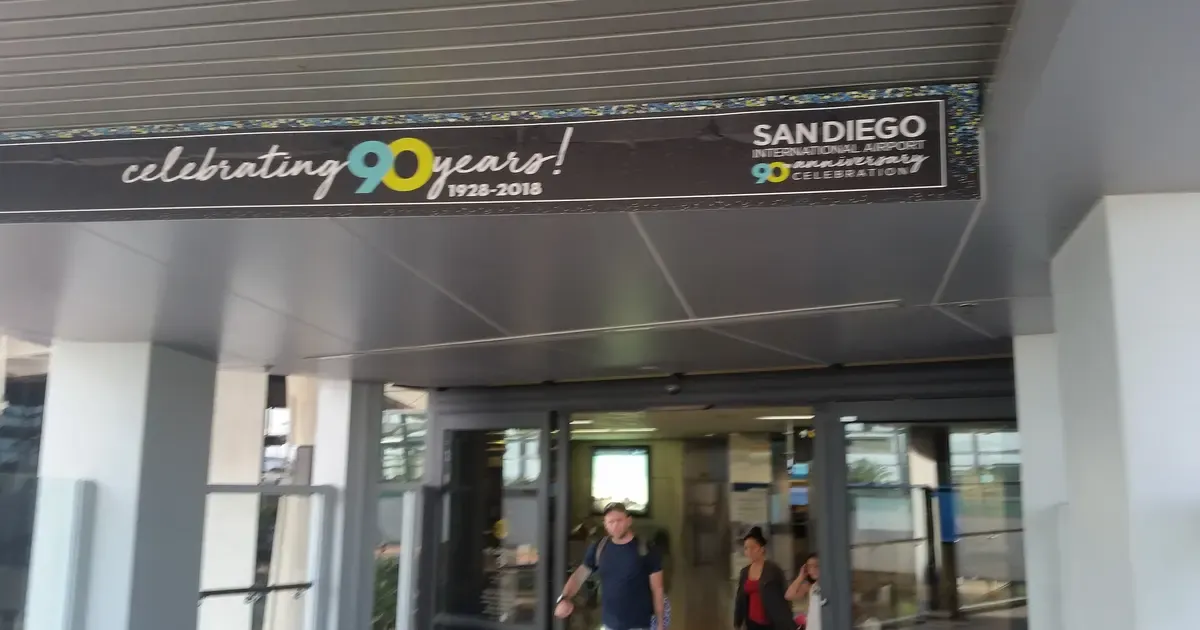
San Diego’s peak TSA wait is 34 minutes. That’s a good number. Denver hits 47, Fort Lauderdale hits 69, Miami hits 46.
Here’s the number that actually matters at SAN: nine. That’s how many hourly slots in a 168-hour week clear at 5 minutes or less.
Nine. For comparison, Kansas City has 109. Buffalo has 97. Even Las Vegas, which nobody calls a relaxing airport, has 29.
The flattest week in the dataset
Most airports have a shape. A morning bank, an afternoon lull, a weekend spike. San Diego has a plateau.
| Day | Worst hour | Wait | Day average |
|---|---|---|---|
| Monday | 5 AM | 24 min | 15.5 min |
| Tuesday | 5 AM | 28 min | 14.5 min |
| Wednesday | 12 PM | 28 min | 16.4 min |
| Thursday | 4 PM | 34 min | 18.7 min |
| Friday | 6 AM | 29 min | 17.9 min |
| Saturday | 5 AM / 7 AM / 11 AM | 19 min | 15.3 min |
| Sunday | 6 AM | 22 min | 16.0 min |
Look at that right column. The best day and the worst day are 4.2 minutes apart. At most airports that gap is ten or fifteen minutes. At Tallahassee it’s thirty-two.
So the standard playbook — fly midweek, fly early, avoid Sunday — buys you almost nothing at SAN. Tuesday isn’t meaningfully easier than Sunday. Six in the morning isn’t meaningfully easier than two in the afternoon.
Why one runway does this
San Diego International runs a single runway on 660 acres wedged between the bay, the harbor, and Balboa Park. There is no room to expand and no room to add checkpoint capacity in any meaningful way. The airport handles well over twenty million passengers a year through a footprint that would be tight for half that.
What that produces is an operation with no slack. There’s no lull hour where volume drops far enough for the queue to drain, because the schedule is packed against the physical ceiling from the first departure to the last. The checkpoint never gets a break, so it never records a 5-minute reading.
The upside of the same constraint: it never blows up either. Thirty-four minutes is genuinely the worst it gets, because the airport can’t physically deliver more passengers to the checkpoint than that in an hour.
What this changes about planning
Ninety minutes, always. Not two hours — the peak doesn’t justify it. Not seventy — there’s no hour where the line is empty. Ninety minutes works for every departure at this airport, seven days a week, and I can’t say that about many places.
Don’t chase a quiet hour. The nine quiet slots cluster at 10 PM and 3 AM. If your flight isn’t in that window, there is no clever timing move available to you. Accept it.
Do check Thursday afternoon. Thursday at 4 PM is the one genuine outlier, and the 1 PM hour that day runs 26. If you’re flying Thursday afternoon, the SAN TSA wait times are worth a look, and add fifteen minutes.
The Thursday thing
Thursday being the worst day is unusual. Most airports peak Sunday (leisure return) or Monday (business departure). San Diego peaks Thursday afternoon, which reads as a mix: the conference crowd leaving after a Tuesday-to-Thursday event, plus the start of the long-weekend leisure outbound.
It’s a genuinely business-and-leisure blended airport, and Thursday is the one day both populations move at once.
The arrivals side, briefly
SAN’s customs hall peaks at 34 minutes on Friday at 2 PM and 3 PM, with Sunday at 4 PM close behind at 32. That’s a mild number for an international arrival — well under Los Angeles at 77 or Seattle at 52.
Same pattern as the departure side, though: flat. Monday’s worst hour is 26 and Friday’s is 34, an eight-minute spread across the week. Whatever hour you land, you’re getting roughly the same experience. The SAN immigration page has the hourly detail if you want to confirm it.
That consistency is worth something. San Diego is not an airport that surprises you. It’s an airport that asks for ninety minutes every single time, and if you give it ninety minutes, you’ll be fine.
Which other airports have this problem?
A short list, and they’re all large.
JFK logs zero hourly slots at five minutes or under. Its daily averages run 17.6 to 22.1 with a peak of 33 minutes on Sunday at 4 PM. There is no quiet hour to find.
LAX logs 10, with a 25-minute peak on Sunday at 9 AM. Houston logs 12, with a 60-minute peak on Sunday at 6 AM. Denver logs 21, Philadelphia 22, Dallas 23, San Jose 25.
San Diego’s nine puts it second only to JFK on this measure, which is remarkable for an airport handling a fraction of JFK’s volume.
The opposite end looks nothing like this: Chicago Midway logs 127, Des Moines 123, Dulles 119, Kansas City 109, Cincinnati 104, Syracuse 100, Buffalo 97.
The practical distinction is whether hour-shifting is a useful strategy. At Midway it is — moving your flight can take you from a queue to a walk-through. At San Diego it isn’t, because every hour is a 15-to-25-minute hour. You can see the contrast on the Midway TSA wait times page.
What does that mean for your buffer?
Set it flat and stop optimizing.
At an airport with real quiet hours, the right approach is to identify the bad windows and book around them. At San Diego there are no good windows, so the only lever is arriving earlier.
Two hours, every departure, regardless of day or hour. That covers the 34-minute Thursday afternoon peak with margin, and it covers the ordinary 18-minute wait with a lot of margin.
The one thing that genuinely helps here is TSA PreCheck. At an airport where the standard lane never clears, having access to a separate lane is worth more than it would be somewhere the main line is already short. If you fly out of San Diego more than a few times a year, it pays for itself faster than the peak numbers suggest.
The San Diego airport guide covers the terminal layout and parking, which at a single-runway airport with constrained curbside is its own planning problem.
Frequently asked questions
What time is TSA busiest at San Diego airport?
Thursday at 4 PM, at 34 minutes. Friday at 6 AM runs 29 and Tuesday at 5 AM and Wednesday at noon both hit 28.
Is San Diego airport ever quiet?
Barely. It logs only 9 hourly slots at 5 minutes or under across the week, and the reliable ones are 10 PM and 3 AM.
How early should I arrive at SAN?
Ninety minutes covers almost any hour, since the peak is only 34 minutes. But don't go below that expecting an empty checkpoint, because there isn't one.
Does flying midweek help at San Diego?
Not much. Tuesday averages 14.5 minutes and Thursday averages 18.7. That four-minute spread is the smallest day-to-day variation of any mid-size airport in the data.
Sources
- TSA PreCheck
Transportation Security Administration · tsa.gov
- TSA checkpoint travel numbers
Transportation Security Administration · tsa.gov
- San Diego International Airport official website
San Diego International Airport · san.org
- TSA PreCheck
Transportation Security Administration · tsa.gov
Keep reading
 securityJFK
When to Arrive at JFK to Dodge the Sunday 4 PM Crush
JFK security peaks at 33 minutes on Sundays at 4 PM, and there's no quiet slot all week. Here's the arrival math that keeps you out of the worst line.
FlyIndex Editorial securityIND
Indianapolis Friday at 6 AM Is a 63-Minute Problem
IND's checkpoint hits 63 minutes on Friday at 6 AM, nearly triple the airport's midweek ceiling. Here's the hourly pattern and an arrival plan by day.
FlyIndex Editorial securityLGA
LaGuardia's Worst TSA Hour Is Sunday at 2 PM: 49 Min
LGA's checkpoint peaks at 49 minutes on Sunday at 2 PM, nearly double any weekday hour. Here's the arrival math for every single day of the LaGuardia week.
FlyIndex Editorial